Switching to solar is one of the smartest financial and environmental decisions a homeowner can make today. With rising electricity tariffs and growing awareness around clean energy, more households across India are exploring rooftop solar installations. However, the solar boom has also led to a flood of installers entering the market. Unfortunately, not all of them meet the same standards for quality, safety, and after-sales support. Choosing the wrong partner can turn your long-term investment into a source of constant frustration.
Before making any down payment, it helps to know what separates a trustworthy installer from a risky one. For instance, homeowners researching a reliable solar company in Pune often find that reputation and transparency matter just as much as pricing. This guide breaks down the key red flags every homeowner should watch for before committing to a rooftop solar installation company in India.
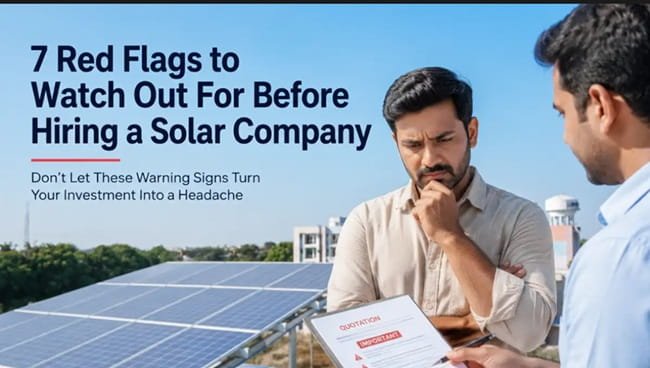
Here are the key red flags to watch out for while hiring a rooftop solar panel company in India –
1. Vague or Missing Component Details
A trustworthy installer will always specify the exact brand, model, and specifications of the solar panels, inverters, and mounting structures being used. If a company avoids sharing this information or keeps switching vendors without explanation, it’s a warning sign. Components matter because they directly affect the system’s efficiency and lifespan. Ask specifically whether the panels meet the ALMM (Approved List of Models and Manufacturers) norms, a government mandate that ensures only quality-certified panels are used in subsidised installations in India.
2. Unrealistic Pricing or Hidden Costs
If a quote seems significantly lower than the market average, it’s worth asking why. Extremely low pricing often means substandard components, undersized systems, or hidden charges that surface later. A reliable installer provides a detailed, itemised quotation upfront, so there are no surprises during installation or afterwards.
3. No Clarity on Net Metering and Subsidy Process
Net metering is what allows homeowners to export surplus solar energy back to the grid. Depending on your local DISCOM’s (Distribution Company) rules, those extra units either get carried forward and adjusted against your bill through the year, or settled and credited to you at the end of the financial year or every month. Many fraudulent or inexperienced installers either skip this step entirely or leave homeowners to navigate DISCOM (Distribution Company) paperwork on their own. A dependable installer should handle the entire net metering application and subsidy documentation, including support for schemes like PM Surya Ghar Muft Bijli Yojana, as part of their service.
4. Weak or Non-Existent Warranty Terms
Rooftop solar is a long-term investment, and warranty coverage should reflect that. Red flags include verbal-only warranty promises, unusually short maintenance periods, or a lack of clarity on what happens if a panel underperforms. Homeowners should always get warranty terms in writing, covering the equipment warranty (typically 10-25 years for panels depending on the panel technology) for panels, mounting structure, inverter, etc.
5. No Physical Site Visit Before Quotation
A genuine installer will always conduct a 360-degree site survey to assess roof strength, shadow analysis, and load-bearing capacity of the rooftop before finalising a quote. Companies that offer a fixed price without ever visiting the site are often cutting corners, which can lead to underperforming systems or structural issues down the line.
6. Poor Communication and Lack of Documentation
From the initial consultation to post-installation support, communication should be clear and consistent. If a company is difficult to reach, delays responses, or fails to provide proper documentation, it signals a lack of professionalism that could translate into poor service down the road.
7. No After-Sales Service or Monitoring Support
Solar systems require regular maintenance, cleaning, and performance monitoring to run efficiently. Installers who disappear after installation, without offering monitoring apps, service visits, or a responsive support team, leave homeowners stranded when issues arise. Choosing a company with a strong after-sales framework ensures long-term peace of mind.
Making an Informed Choice
Rooftop solar is not just a purchase; it’s a long-term partnership with the installer. Homeowners evaluating a solar panel for home should treat the decision with the same diligence as any major home investment. Check credentials, read company reviews, compare warranty terms, and ask detailed questions before signing anything with any solar panel company.
Many solar companies are offering different benefits, but only some of them stand on those promises. Companies like SolarSquare have built their reputation around transparency, using certified components, providing detailed documentation, and offering structured after-sales support, which is the kind of accountability every homeowner should look for regardless of which installer they choose. SolarSquare is India’s #1 home solar brand as per the PM Surya Ghar Government Portal in India.
Final Thoughts
The solar industry’s rapid growth means more options for consumers, but also more room for inconsistency. By watching for these red flags – vague component details, unrealistic pricing, unclear net metering support, weak warranties, skipped site visits, poor communication, and absent after-sales service – homeowners can filter out unreliable players of the market and choose an installer that will support their solar journey for decades to come.