India’s two-wheeler industry, one of the largest in the world, continues to evolve in 2025. With its significant contribution to the Indian economy and its role in everyday transportation, understanding the sector’s current strengths, weaknesses, opportunities, and threats is crucial for stakeholders. Here’s a comprehensive SWOT analysis of the Indian two-wheeler industry in 2025.
Strengths
1. Market Size and Demand
- India boasts one of the largest two-wheeler markets globally, with annual sales exceeding 20 million units.
- Two-wheelers are an affordable and convenient mode of transportation for millions of Indians, especially in semi-urban and rural areas.
2. Affordability and Versatility
- Indian manufacturers like Hero MotoCorp, Bajaj Auto, and TVS offer a wide range of models catering to diverse consumer needs.
- Low manufacturing costs enable competitive pricing, making two-wheelers accessible to the masses.
3. Export Potential
- Indian two-wheeler manufacturers have a strong export presence, with countries in Africa, Latin America, and Southeast Asia being major markets.
- The industry is increasingly focusing on premium bikes for international markets, boosting revenue streams.
4. Adaptability to Electric Mobility
- Leading players like Ola Electric, Ather Energy, and TVS have introduced affordable and efficient electric scooters and motorcycles.
- The government’s push toward electric mobility (FAME II subsidies) has accelerated the adoption of electric two-wheelers.
5. Technological Advancements
- Integration of smart technologies, including IoT-based tracking, navigation, and enhanced safety features, is making two-wheelers more appealing.
- Companies are investing in R&D for better battery technology and fuel efficiency.
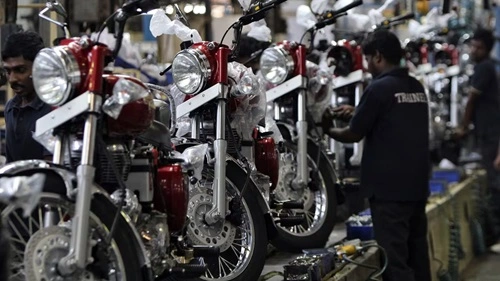
6. Strong Domestic Manufacturing Base
- India’s well-established automotive manufacturing ecosystem supports the production of two-wheelers at scale.
- Availability of skilled labor and raw materials adds to the industry’s strength.
Weaknesses
1. Dependence on Imports for EV Components
- Despite advancements, India remains heavily reliant on imports for crucial components like lithium-ion batteries and semiconductors.
- This dependency increases production costs and hampers supply chain efficiency.
2. Limited Charging Infrastructure
- While electric two-wheelers are gaining traction, the lack of widespread charging infrastructure continues to be a bottleneck for adoption.
- Range anxiety and slow expansion of charging networks deter potential buyers.
3. Environmental Concerns
- The traditional two-wheeler segment, dominated by internal combustion engines, contributes significantly to air pollution.
- Stricter emission norms, though necessary, increase manufacturing costs, impacting affordability.
4. Fragmented Market
- The presence of numerous players, from established giants to new entrants, leads to intense competition and price wars.
- Smaller manufacturers often struggle to maintain profitability in such a competitive environment.
5. Inadequate After-Sales Service
- In semi-urban and rural areas, after-sales services, including repair and maintenance, remain subpar.
- Lack of skilled technicians for electric two-wheelers poses additional challenges.
Opportunities
1. Electric Mobility Revolution
- The transition to electric two-wheelers represents a massive growth opportunity.
- With government incentives like FAME II, lower GST on EVs, and state-level subsidies, the demand for electric scooters and motorcycles is expected to soar.
2. Rural Market Expansion
- Rural India offers untapped potential, where two-wheelers serve as the primary mode of transport due to inadequate public transport systems.
- Increased agricultural income and government rural development programs are boosting purchasing power in these regions.
3. Premium Segment Growth
- Rising disposable incomes and changing consumer preferences are driving demand for premium motorcycles.
- International brands like Harley-Davidson, KTM, and Triumph are capitalizing on this trend by entering joint ventures with Indian firms.
4. Sustainability Initiatives
- Growing awareness of environmental issues has prompted consumers to prefer eco-friendly vehicles.
- Companies can gain a competitive edge by investing in greener technologies and sustainable manufacturing practices.
5. Digital Transformation
- The integration of AI, machine learning, and IoT in two-wheelers opens up possibilities for connected vehicles.
- Enhanced features like navigation systems, ride analytics, and safety alerts are attracting tech-savvy consumers.
6. Government Policies
- Favorable policies, including the extension of production-linked incentive (PLI) schemes, encourage investment in the sector.
- The focus on “Make in India” is pushing manufacturers to localize production, reducing reliance on imports.
Threats
1. Economic Slowdowns
- Inflation and fluctuating fuel prices can impact the purchasing power of middle and lower-income groups, the primary consumers of two-wheelers.
- Global economic uncertainties may also affect exports and investment flows.
2. Regulatory Challenges
- Stricter emission norms like BS6 and potential transitions to BS7 standards increase costs for manufacturers.
- Frequent policy changes in the EV segment create uncertainty for investors and consumers.
3. Intense Competition
- Domestic and international brands, along with new-age EV startups, are vying for market share, intensifying competition.
- The price wars in the entry-level segment could erode profit margins.
4. Technological Obsolescence
- Rapid technological advancements pose the risk of current models becoming obsolete quickly.
- Companies failing to innovate may lose their market position.
5. Supply Chain Disruptions
- Geopolitical tensions and global supply chain disruptions, particularly in semiconductor and battery supplies, can hamper production.
- Dependency on imports for critical components remains a significant vulnerability.
6. Consumer Skepticism Towards EVs
- Despite incentives, consumers remain skeptical about the long-term reliability and cost-effectiveness of electric two-wheelers.
- Misinformation and limited awareness about EV benefits hinder adoption.
Conclusion
The two-wheeler industry in India in 2025 is at a pivotal juncture, balancing traditional strengths with the need for innovation and sustainability. While the industry has an edge due to its vast domestic market, robust manufacturing base, and export potential, challenges such as supply chain vulnerabilities, environmental concerns, and stiff competition require immediate attention.
To remain competitive, manufacturers must focus on technological advancements, strengthen their EV portfolios, and address infrastructure gaps. Strategic collaborations, investment in R&D, and alignment with government policies will be key to unlocking the industry’s potential and ensuring long-term growth. As India continues its journey towards sustainable mobility, the two-wheeler sector is poised to play a transformative role in shaping the future of transportation.